

 SING YEREVAN SING November 22 at 7PM Call:(818) 265-0506 TSANKAPAT (THE FENCE) November 15,at 7:00PM Call:(626)545-0404 Romeo and Juliet: Deja Vu, December 6 at 7:00PM,Call:(818)265-0506
  Christmas Bazaar with Santa Claus November 15 , Call:(310) 746-6181
 George Gurdjieff
Tuesday, January 13, 2026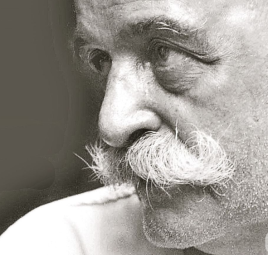
George Ivanovich Gurdjieff (c. 1866–1877 – 29 October 1949) was a philosopher, mystic, spiritual teacher, composer, and movements teacher.
Born in the Russian Empire, he briefly became a citizen of the First Republic of Armenia after its formation in 1918, but fled the impending Red Army invasion of Armenia in 1920, which rendered him stateless. In the early 1920s, he applied for British citizenship, but his application was denied. He then settled in France, where he lived and taught for the rest of his life.
Gurdjieff taught that people are not conscious of themselves and thus live their lives in a state of hypnotic "waking sleep", but that it is possible to awaken to a higher state of consciousness and serve our purpose as human beings. His student P. D. Ouspensky referred to Gurdjieff's teachings as the "Fourth Way".
Gurdjieff's teaching has inspired the formation of many groups around the world. After his death in 1949, the Gurdjieff Foundation in Paris was established and led by his close pupil Jeanne de Salzmann in cooperation with other direct pupils of Gurdjieff, until her death in 1990; and then by her son Michel de Salzmann, until his death in 2001.
The International Association of the Gurdjieff Foundations comprises the Institut Gurdjieff in France; The Gurdjieff Foundation in the USA; The Gurdjieff Society in the UK; and the Gurdjieff Foundation in Venezuela.
Gurdjieff was born in Alexandropol, Yerevan Governorate, Russian Empire (now Gyumri, Armenia). His father Ivan Ivanovich Gurdjieff was Greek, and a renowned ashugh under the pseudonym of Adash, who in the 1870s managed large herds of cattle and sheep. The long-held view is that Gurdjieff's mother was Armenian, although some scholars have recently speculated that she too was Greek. According to Gurdjieff himself, his father came of a Greek family whose ancestors had emigrated from Byzantium after the Fall of Constantinople in 1453, with his family initially moving to central Anatolia, and from there eventually to Georgia in the Caucasus.
There are conflicting views regarding Gurdjieff's birth date, ranging from 1866 to 1877. The bulk of extant records weigh heavily toward 1877, but Gurdjieff in reported conversations with students gave the year of his birth as c. 1867, which is corroborated by the account of his niece Luba Gurdjieff Everitt. George Kiourtzidis, great-grandson of Gurdjieff's paternal uncle Vasilii (through Vasilii's son Alexander), recalled that his grandfather Alexander, born in 1875, said that Gurdjieff was about three years older than him, which would point to a birth date c. 1872. A number of scholars have also tried to deduce Gurdjieff's year of birth by analyzing an incident of a cattle plague he wrote about in his book Meetings with Remarkable Men, where Gurdjieff claimed he was about seven years old at the time of the calamity; its occurrence has been dated by James Moore to 1873, by Mohammad H. Tamdgidi to 1879, by Paul Beekman Taylor to either 1877 or 1884, and by Tobias Churton to c. 1883–1884. According to Tamdgidi, the confusion surrounding Gurdjieff's year of birth:
was an example of a whole series of puzzles, signposts, and difficulties Gurdjieff deliberately created for his pupils, readers, and posterity, for specific reasons that are inseparable from the method and aims of his teaching. As Gurdjieff later discovered about the nature and purpose of "ancient art," "lawful inexactitudes" consciously and intentionally placed in artwork (and in this case, in his own writings) play significant roles in the transmission of important information to future generations.
Although official documents consistently record the day of his birth as 28 December, Gurdjieff himself celebrated his birthday either on the Old OrthodoxJulian calendar date of 1 January, or according to the Gregorian calendar date for New Year of 13 January (up to 1899; 14 January after 1900). The year of 1872 is inscribed in a plate on the grave-marker in the cemetery of Avon, Seine-et-Marne, France, where his body was buried.
Gurdjieff spent his childhood in Kars, which, from 1878 to 1918, was the administrative capital of the Russian-ruled Transcaucasus province of Kars Oblast, a border region recently acquired following the defeat of the Ottoman Empire. It contained extensive grassy plateau-steppe and high mountains, and was inhabited by a multi-ethnic and multi-confessional population that had a history of respect for travelling mystics and holy men, and for religious syncretism and conversion. Both the city of Kars and the surrounding territory were home to an extremely diverse population: although part of the Armenian Plateau, the Russian-ruled Transcaucasus province of Kars Oblast was home to Armenians, Caucasus Greeks, Pontic Greeks, Georgians, Russians, Kurds, Turks, and smaller numbers of Christian communities from eastern and central Europe such as Caucasus Germans, Estonians, and Russian Orthodox sectarian communities like the Molokans, Doukhobors, Pryguny, and Subbotniks.
Gurdjieff makes particular mention of the Yazidi community. Growing up in a multi-ethnic society, Gurdjieff became fluent in Armenian, Pontic Greek, Russian, and Turkish, speaking the last in a mixture of elegant Ottoman Turkish with some dialect. He later acquired "a working facility with several European languages".
Early influences on him included his father, a carpenter and amateur ashik or bardic poet, and the priest of the town's cathedral, Dean Borsh, a family friend. The young Gurdjieff avidly read literature from many sources and influenced by these writings and witnessing a number of phenomena that he could not explain, he formed the conviction that there existed a hidden truth known to mankind in the past, which could not be ascertained from science or mainstream religion.
In early adulthood, according to his own account, Gurdjieff's search for such knowledge led him to travel widely to Central Asia, Egypt, Iran, India, Tibet and other places before he returned to Russia for a few years in 1912. He was never forthcoming about the source of his teaching, which he once labelled as esoteric Christianity, in that it ascribes a psychological rather than a literal meaning to various parables and statements found in the Bible. The only account of his wanderings appears in his book Meetings with Remarkable Men, which is not generally considered to be a reliable autobiography. One example is of the adventure of walking across the Gobi desert on stilts, where Gurdjieff said he was able to look down on the contours of the sand dunes while the sand storm whirled around below him. Each chapter is named after a "remarkable man", some of whom were putative members of a society called "The Seekers of Truth".
After Gurdjieff's death, J. G. Bennett researched his potential sources and suggested that the men were symbolic of the three types of people to whom Gurdjieff referred: No. 1 centred in their physical body; No. 2 centred in their emotions and No. 3 centred in their mind. Gurdjieff describes how he encountered dervishes, fakirs and descendants of the Essenes, whose teaching he said had been conserved at a monastery in Sarmoung. The book also has an overarching quest involving a map of "pre-sand Egypt" and culminates in an encounter with the "Sarmoung Brotherhood".
Gurdjieff wrote that he supported himself during his travels by engaging in various enterprises such as running a travelling repair shop and making paper flowers; and on one occasion while thinking about what he could do, he described catching sparrows in the park and then dyeing them yellow to be sold as canaries; It is also speculated by commentators that during his travels he was engaged in a certain amount of political activity, as part of The Great Game.
From 1913 to 1949, the chronology appears to be based on material that can be confirmed by primary documents, independent witnesses, cross-references and reasonable inference. On New Year's Day in 1912, Gurdjieff arrived in Moscow and attracted his first students, including his cousin, the sculptor Sergey Merkurov, and the eccentric Rachmilievitch. In the same year, he married Julia Ostrowska, a Pole, in Saint Petersburg. In 1914, Gurdjieff advertised his ballet, The Struggle of the Magicians, and he supervised his pupils' writing of the sketch Glimpses of Truth.
In 1915, Gurdjieff accepted P. D. Ouspensky as a pupil, and in 1916, he accepted the composer Thomas de Hartmann and his wife, Olga, as students. He then had about 30 pupils. Ouspensky already had a reputation as a writer on mystical subjects and had conducted his own, ultimately disappointing, search for wisdom in the East. The Fourth Way "system" taught during this period was complex and metaphysical, partly expressed in scientific terminology.[citation needed]
During the revolutionary upheaval in Russia, Gurdjieff left Petrograd in 1917 to return to his family home in Alexandropol (present-day Gyumri in Armenia). During the October Revolution, he set up a temporary study community in Essentuki in the Caucasus, where he worked intensively with a small group of Russian pupils. Gurdjieff's eldest sister Anna and her family later arrived there as refugees, informing him that Turks had shot his father in Alexandropol on 15 May. As the area became increasingly threatened by civil war, Gurdjieff fabricated a newspaper story announcing his forthcoming "scientific expedition" to "Mount Induc". Posing as a scientist and wearing a red fireman's belt with brass rings Gurdjieff left Essentuki with fourteen companions (excluding Gurdjieff's family and Ouspensky). They travelled by train to Maikop, where hostilities delayed them for three weeks. In the spring of 1919, Gurdjieff met the artist Alexandre de Salzmann and his wife Jeanne and accepted them as pupils. Assisted by Jeanne de Salzmann, Gurdjieff gave the first public demonstration of his Sacred Dances (Movements at the Tbilisi Opera House, 22 June).
In March 1918, Ouspensky separated from Gurdjieff, settling in England and teaching the Fourth Way in his own right. The two men were to have a very ambivalent relationship for decades to come.
In 1919, Gurdjieff and his closest pupils moved to Tbilisi, Georgia, where Gurdjieff's wife Julia Ostrowska, the Stjoernvals, the Hartmanns, and the de Salzmanns continued to assimilate his teaching. Gurdjieff concentrated on his still unstaged ballet, The Struggle of the Magicians. Thomas de Hartmann (who had made his debut years ago, before TsarNicholas II of Russia), worked on the music for the ballet, and Olga Ivanovna Hinzenberg (who years later wed the American architect Frank Lloyd Wright), practiced the dances. It was here that Gurdjieff opened his first Institute for the Harmonious Development of Man.
In late May 1920, when political and social conditions in Georgia deteriorated, his party travelled to Batumi on the Black Sea coast and then by ship to Constantinople (today Istanbul). Gurdjieff rented an apartment on Kumbaracı Street in Péra and later at 13 Abdullatif Yemeneci Sokak near the Galata Tower. The apartment is near the Khanqah (Sufi lodge) of the Mevlevi Order (a Sufi order following the teachings of Jalal al-Din Muhammad Rumi), where Gurdjieff, Ouspensky and Thomas de Hartmann witnessed the Sama ceremony of the Whirling Dervishes. In Istanbul, Gurdjieff also met his future pupil, Capt. John G. Bennett, then head of the British Directorate of Military Intelligence in Ottoman Turkey, who described his impression of Gurdjieff as follows:
It was there that I first met Gurdjieff in the autumn of 1920, and no surroundings could have been more appropriate. In Gurdjieff, East and West do not just meet. Their difference is annihilated in a world outlook which knows no distinctions of race or creed. This was my first, and has remained one of my strongest impressions. A Greek from the Caucasus, he spoke Turkish with an accent of unexpected purity, the accent that one associates with those born and bred in the narrow circle of the Imperial Court. His appearance was striking enough even in Turkey, where one saw many unusual types. His head was shaven, immense black moustache, eyes which at one moment seemed very pale and at another almost black. Below average height, he gave nevertheless an impression of great physical strength.
In August 1921 and 1922, Gurdjieff travelled around western Europe, lecturing and giving demonstrations of his work in various cities, such as Berlin and London. He attracted the allegiance of Ouspensky's many prominent pupils (notably the editor A. R. Orage). After an unsuccessful attempt to gain British citizenship, Gurdjieff established the Institute for the Harmonious Development of Man south of Paris at the Prieuré des Basses Loges in Avon near the famous Château de Fontainebleau. The once-impressive but somewhat crumbling mansion set in extensive grounds housed an entourage of several dozen, including some of Gurdjieff's remaining relatives and some White Russian refugees. Gurdjieff is quoted by his students in Views from the Real World as saying: "The Institute can help one to be able to be a Christian." An aphorism was displayed which stated: "Here there are neither Russians nor English, Jews nor Christians, but only those who pursue one aim – to be able to be."
New pupils included C. S. Nott, René Zuber , Margaret Anderson and her ward Fritz Peters. The intellectual and middle-class types who were attracted to Gurdjieff's teaching often found the Prieuré's spartan accommodation and emphasis on hard labour on the grounds disconcerting. Gurdjieff was putting into practice his teaching that people need to develop physically, emotionally and intellectually, so lectures, music, dance, and manual work were organised. Older pupils noticed how the Prieuré teaching differed from the complex metaphysical "system" that had been taught in Russia. In addition to the physical hardships, his personal behaviour towards pupils could be ferocious:
Gurdjieff was standing by his bed in a state of what seemed to me to be completely uncontrolled fury. He was raging at Orage, who stood impassively and very pale, framed in one of the windows... Suddenly, in the space of an instant, Gurdjieff's voice stopped, his whole personality changed and he gave me a broad smile—and looking incredibly peaceful and inwardly quiet, motioned me to leave. He then resumed his tirade with undiminished force. This happened so quickly that I do not believe that Mr. Orage even noticed the break in the rhythm.
During this period, Gurdjieff acquired notoriety as "the man who killed Katherine Mansfield" after Katherine Mansfield died there of tuberculosis on 9 January 1923. However, James Moore and Ouspensky argue that Mansfield knew she would soon die and that Gurdjieff made her last days happy and fulfilling.
Starting in 1924, Gurdjieff made visits to North America, where he eventually received the pupils taught previously by A. R. Orage. In 1924, while driving alone from Paris to Fontainebleau, he had a near-fatal car accident. Nursed by his wife and mother, he made a slow and painful recovery against all medical expectations. Still convalescent, he formally "disbanded" his institute on 26 August (in fact he dispersed only his "less dedicated" pupils) which he expressed was a personal undertaking: "in the future, under the pretext of different worthy reasons, to remove from my eyesight all those who by this or that make my life too comfortable".
While recovering from his injuries and still too weak to write himself, he began to dictate his magnum opus, Beelzebub's Tales, the first part of All and Everything, in a mixture of Armenian and Russian. The book is generally found to be convoluted and obscure and forces the reader to "work" to find its meaning. He continued to develop the book over some years, writing in noisy cafes which he found conducive for setting down his thoughts.
Gurdjieff's mother died in 1925 and his wife developed cancer and died in June 1926. Ouspensky attended her funeral. According to the writer Fritz Peters, Gurdjieff was in New York from November 1925 to the spring of 1926, when he succeeded in raising over $100,000. He was to make six or seven trips to the US, but alienated a number of people with his brash and impudent demands for money.
A Chicago-based Gurdjieff group was founded by Jean Toomer in 1927 after he had trained at the Prieuré for a year. Diana Huebert was a regular member of the Chicago group, and documented the several visits Gurdjieff made to the group in 1932 and 1934 in her memoirs on the man.
Despite his fund-raising efforts in America, the Prieuré operation ran into debt and was shut down in 1932. Gurdjieff constituted a new teaching group in Paris. Known as The Rope, it was composed of only women, many of them writers, and several lesbians. Members included Kathryn Hulme, Jane Heap, Margaret Anderson and Enrico Caruso's widow, Dorothy. Gurdjieff became acquainted with Gertrude Stein through its members, but she was never a follower.
In 1935, Gurdjieff stopped work on All and Everything. He had completed the first two parts of the planned trilogy but then started on the Third Series. (It was later published under the title Life Is Real Only Then, When 'I Am'.) In 1936, he settled in a flat at 6, Rue des Colonels-Renard in Paris, where he was to stay for the rest of his life. In 1937, his brother Dmitry died, and The Rope disbanded.
Although the flat at 6 Rue des Colonels-Renard was very small, he continued to teach groups of pupils there throughout the war. Visitors have described his pantry or 'inner sanctum' as being stocked with an extraordinary collection of eastern delicacies. The suppers he held included elaborate toasts to 'idiots', drunk with vodka and cognac.Having cut a physically impressive figure for many years, he was now paunchy. His teaching was now conveyed more directly through personal interaction with his pupils, who were encouraged to study the ideas he had expressed in Beelzebub's Tales.
His personal business enterprises (including intermittently dealing in oriental rugs and carpets for much of his life, among other activities) enabled him to offer charitable relief to neighbours who had been affected by the difficult circumstances of the war, and it also brought him to the attention of the authorities, leading to a night in the cells.
After the war, Gurdjieff tried to reconnect with his former pupils. Ouspensky was hesitant, but after his death (October 1947), his widow advised his remaining pupils to see Gurdjieff in Paris. J. G. Bennett also visited from England, their first meeting in 25 years. Ouspensky's pupils in England had all thought that Gurdjieff was dead. They discovered he was alive only after the death of Ouspensky, who had not told them that Gurdjieff, from whom he had learnt of the teaching, was still living. They were overjoyed and many of Ouspensky's pupils including Rina Hands, Basil Tilley and Catherine Murphy visited Gurdjieff in Paris. Hands and Murphy worked on the typing and retyping for the publication of All and Everything.[citation needed]
Gurdjieff suffered a second car accident in 1948 but again made an unexpected recovery.
"I was looking at a dying man. Even this is not enough to express it. It was a dead man, a corpse, that came out of the car; and yet it walked. I was shivering like someone who sees a ghost." With iron-like tenacity, he managed to get to his room, where he sat down and said: "Now all organs are destroyed. Must make new". Then, he turned to Bennett, smiling: "Tonight you come dinner. I must make body work". As he spoke, a great spasm of pain shook his body and blood gushed from an ear. Bennett thought: "He has a cerebral haemorrhage. He will kill himself if he continues to force his body to move". But then he reflected: "He has to do all this. If he allows his body to stop moving, he will die. He has power over his body".
After recovering, Gurdjieff finalised plans for the official publication of Beelzebub's Tales and made two trips to New York. He also visited the famous prehistoric cave paintings at Lascaux, giving his interpretation of their significance to his pupils.
Gurdjieff died of cancer at the American Hospital in Neuilly-sur-Seine, France, on 29 October 1949. His funeral took place at the St. Alexandre Nevsky Russian Orthodox Cathedral at 12 Rue Daru, Paris. He is buried in the cemetery at Avon (near Fontainebleau).